Quick answer
Dental care for older adults should prioritise comfortable eating, infection prevention and a routine that can be maintained realistically. Age alone does not determine treatment suitability. Medicines, dry mouth, general health, hand strength and caregiver support can affect the plan. Preserving useful teeth and simplifying cleaning may be more valuable than choosing the most complex available reconstruction.
A useful plan starts with daily life
For an older adult, the best dental plan may prioritise comfortable chewing, manageable cleaning and fewer emergencies over an ambitious cosmetic change. Age alone does not determine suitability for treatment. Ask about the person’s goals, dexterity, medical conditions and ability to attend reviews. If a family member assists with care, include them with the patient’s permission. A technically elaborate restoration is not necessarily the best option if it is difficult to clean or maintain.
Medicines and dryness deserve attention
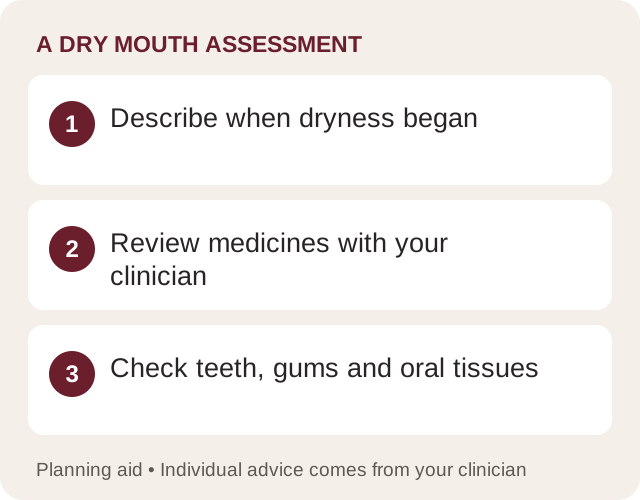
Older adults often take several medicines, some of which can contribute to dry mouth or affect dental planning. Bring a complete list and describe any recent changes. Do not assume that persistent dryness is an unavoidable consequence of ageing. Reduced saliva can make eating uncomfortable and increase decay risk, especially around exposed roots and existing restorations. The dentist may coordinate with the medical team and recommend a prevention plan that is more intensive than routine advice.
Assess the whole mouth before replacing teeth
A decision about a missing tooth should account for the remaining teeth, existing dentures, chewing needs and ability to tolerate procedures. An implant, bridge or removable option may each have advantages and limitations. Ask how the proposed result will be cleaned, what repairs are likely to involve and what happens if health or mobility changes later. Preserving useful natural teeth and repairing a serviceable prosthesis may sometimes be preferable to starting an extensive new reconstruction.
Make home care physically achievable
A larger toothbrush handle, a powered brush or adapted interdental tools may help when hand movement is limited. The clinician should demonstrate techniques that the patient or caregiver can realistically perform. Dentures also require a cleaning routine and checks for fit and tissue irritation. New soreness, difficulty eating or unexplained changes in the mouth deserve assessment even when there are no natural teeth. Preventive care continues throughout life and should adapt as needs change.
International treatment needs a maintenance plan
Before an older relative travels to Seoul for dental care, consider fatigue, mobility, communication, medical support and the number of return visits. Do not assess the plan only by the initial treatment price. Obtain records and arrange who will maintain the work at home. A staged approach may reduce the burden of long appointments and allow the patient to judge comfort before proceeding further. The most successful result supports everyday function without creating an unmanageable new care obligation.
Discuss future changes in care needs
Ask whether the proposed restoration will remain manageable if hand strength, mobility or general health declines. A plan can include simpler cleaning access and repair options from the outset. Thinking ahead is particularly valuable before choosing a complex reconstruction that will need regular specialist maintenance.
Patient questions
Is losing teeth an inevitable part of ageing?
No. Teeth can remain functional throughout life with suitable prevention and treatment. New pain, looseness or difficulty eating should be assessed rather than dismissed as normal ageing.
How can cleaning be adapted for reduced hand strength?
An easier-to-hold or powered brush and appropriately chosen interdental tools may help. A dental team can demonstrate adaptations and involve a caregiver when the patient agrees.
Explore related care in Seoul
These profiles describe published clinical interests and services. Compare the team and ask whether the proposed care fits your diagnosis.
- OnO Dental Clinic — Sinsa · Gangnam
- Dr. Se Hong Oh — Bite function, jaw-joint care and orthodontic treatment at OnO Dental Clinic.
Clinical references and further reading for the explanations on this page. The guide is general patient education; your dentist determines the plan for your examination findings.
National Institute on Aging: teeth and mouth >NIDCR: dry mouth >