Quick answer
A dental mock-up or digital smile preview helps you discuss tooth shape, length and arrangement before committing to treatment. It is a planning aid, not a guarantee of the final result. Ask what it represents, test speech and thickness where a physical trial is possible, and compare less invasive ways to reach the same goal.
Start with your priorities
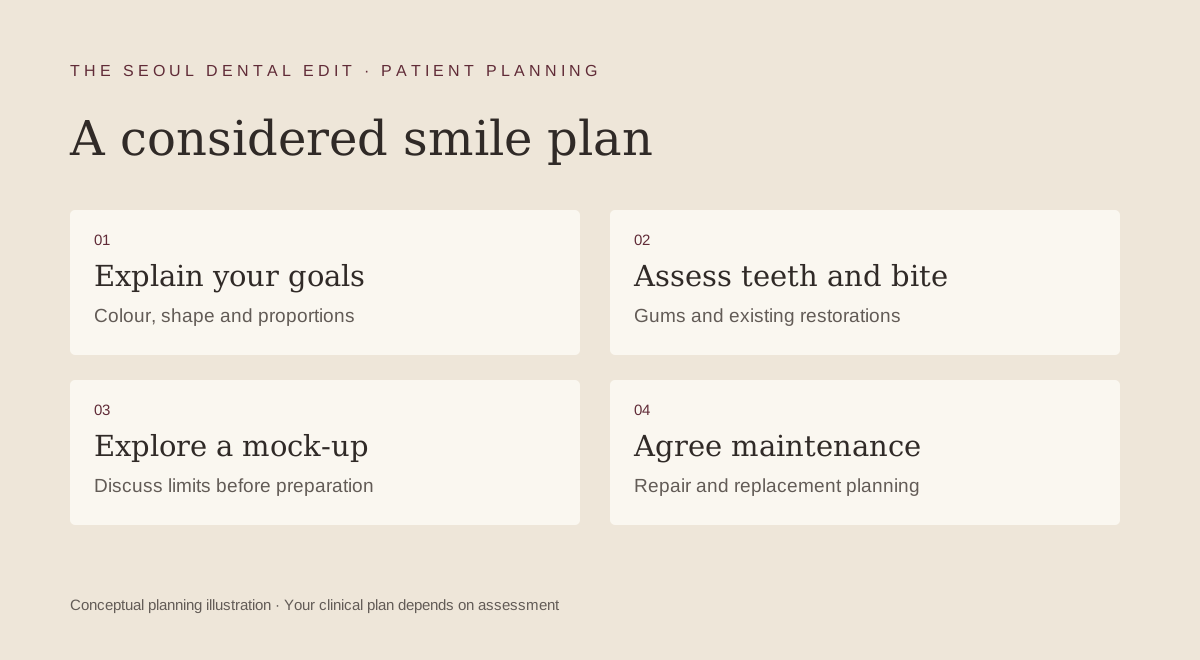
Smile design is a planning process, not a single treatment. It may involve photographs, scans, models or a trial restoration to discuss changes in tooth shape, colour and arrangement. Begin by describing what bothers you and what you want to preserve. A distinctive tooth shape or a small asymmetry may be part of your identity rather than a defect. Ask the clinician to separate concerns that affect health or function from changes that are purely aesthetic. This keeps the plan focused on your goals.
Look beyond a front-facing photograph
Teeth are seen while you speak, laugh and rest, and they must work during chewing. A preview should consider lip support, tooth display, proportions and the relationship to the opposing teeth. Ask to view the design from different angles and, where appropriate, try a physical mock-up. Speak aloud and notice whether added length or thickness feels intrusive. A digital image can help communication, but it cannot fully reproduce the sensation or function of a restoration in your mouth.
Understand what the mock-up represents
Some mock-ups are placed over unprepared teeth and may be bulkier than the final result. Others are based on a planned preparation or a temporary restoration. Ask which type you are seeing and what uncertainties remain. The final material, colour of the underlying tooth and gum response can affect the outcome. A preview should support informed consent rather than create the impression that every detail of a computer-generated image is guaranteed.
Use the preview to compare treatments
The same visual goal might be approached with orthodontics, whitening, bonding, veneers or a combination. Ask which option preserves the most sound tooth and which requires ongoing maintenance. If a design needs extensive crown preparation on healthy teeth, discuss why less invasive approaches are unsuitable. A staged plan can allow you to reassess after a smaller change. There is no obligation to proceed to every proposed step simply because a full makeover has been visualised.
Record your decisions before irreversible work
Agree on tooth length, broad shape and colour goals, and clarify when you can request changes. Ask whether adjustments to the mock-up or temporaries are included in the fee. For a Seoul visit, allow time between preview and preparation so you can consider the proposal without travel pressure. Keep a copy of the agreed plan and understand the limits of visual prediction. The value of smile design is better communication and a more deliberate treatment choice, not a promise of perfection.
Invite clear feedback
If a preview feels too long, too bright or too uniform, say so specifically. Ask the clinician to describe what can be changed and what is limited by your bite or existing tooth position.
Patient questions
Will my final veneers look exactly like a digital preview?
That should not be assumed. Material, the underlying tooth, preparation, gums and lighting can affect the result. Ask which aspects the preview can predict and which remain uncertain, and clarify when you can approve or request changes to the final appearance.
What should I test in a physical smile mock-up?
Look at tooth display at rest and while smiling, speak aloud and assess added thickness from different angles. Tell the dentist if the design feels too long, bulky or uniform. The preview also needs a clinical bite assessment, not just a photograph.
Explore related care in Seoul
These profiles describe published clinical interests and services. Compare the team and ask whether the proposed care fits your diagnosis.
- OnO Dental Clinic — Sinsa · Gangnam
- Smile View Dental — Gangnam · Sinnonhyeon
- Dr. Hoijin Oh — Aesthetic dentistry and prosthodontic care at OnO Dental Clinic.
- Dr. Han-gyeol Kim — Integrated dentistry and smile planning at Smile View Dental.
Clinical references and further reading for the explanations on this page. The guide is general patient education; your dentist determines the plan for your examination findings.
American Dental Association: Veneers >Leeds Teaching Hospitals: Crowns >NHS: Teeth whitening >