Quick answer
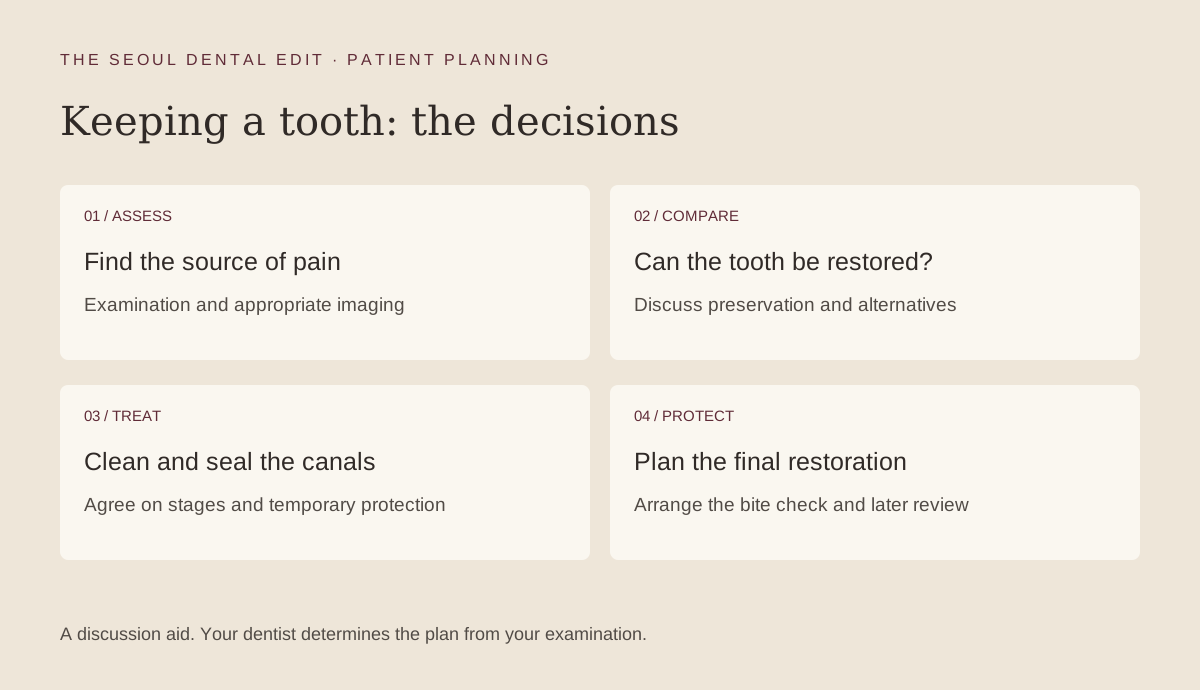
The choice between root canal treatment and extraction depends on whether the tooth can be restored, supported and maintained with a reasonable prognosis. Root canal care preserves a suitable natural tooth; extraction permanently removes it and may lead to replacement treatment. Compare the complete pathways, including restoration or replacement, healing, follow-up and future maintenance rather than individual procedure fees.
Begin with whether the tooth is maintainable
The most useful question is not which procedure is generally better, but whether your tooth can be restored and kept clean with a reasonable prognosis. Root canal treatment can address disease inside a suitable tooth; it cannot correct every deep fracture, extensive loss of structure or severe supporting-bone problem. Ask the dentist to show which findings support preservation or extraction. If a recommendation is irreversible and the prognosis is uncertain, a specialist assessment or second opinion may help you understand the alternatives before committing.
Compare whole pathways rather than single appointments
Preserving a tooth may involve root canal treatment, a core and a final restoration, with review afterwards. Extraction may be followed by no replacement, a removable appliance, a bridge or an implant-supported restoration, depending on function and circumstances. Each option carries its own treatment time and maintenance obligations. A low extraction fee does not describe the cost or experience of replacing the tooth. Likewise, a root canal quotation that excludes the final restoration understates the complete preservation pathway. Request written plans that include each stage.
Function and future choices matter
Consider the tooth's position, the health of neighbouring teeth, chewing needs and the effect of a gap. A replacement that requires treatment of adjacent teeth may have different implications from an implant or removable option. Preservation can retain natural tooth structure, but a severely compromised tooth may need repeated intervention. Extraction is permanent and may affect future bone and soft-tissue conditions. Ask what is likely to happen if you choose each pathway and what could limit later options. There is rarely a meaningful answer based only on age or a cosmetic photograph.
Account for your actual travel capacity
A visitor may prefer the fastest procedure, yet speed can be misleading when later visits are required. Root canal completion and restoration may need more than one appointment; implant treatment commonly involves staged planning and healing. If your stay in Korea is short, ask what can be completed safely, what will remain temporary and who will provide follow-up at home. Avoid letting a prebooked flight become the principal reason for removing a potentially restorable tooth or rushing a permanent replacement.
Make uncertainty explicit
Ask the clinician to explain the best-case and less favourable outcomes for your specific tooth without presenting a guarantee. What findings could change the plan during treatment? What additional costs might follow? Who manages a problem after you leave? Request copies of the examination, images and proposed sequence. A decision can be reasonable even when no option is perfect, provided the trade-offs are clear. Choose a plan that you can maintain and complete, with a credible route for review, rather than the option that sounds most definitive in advertising.
Patient questions
Is extraction always the cheaper overall option?
The removal fee alone is not a complete comparison. If you want the tooth replaced, include the bridge, denture or implant pathway and follow-up. Likewise, include the final restoration when comparing a root canal plan.
When is a second opinion useful before extraction?
It may help when the tooth’s restorability or prognosis is uncertain and there is time to obtain one safely. Ask the clinician to explain the structural, periodontal or fracture findings behind the recommendation.
Explore related care in Seoul
These profiles describe published clinical interests and services. Compare the team and ask whether the proposed care fits your diagnosis.
- Lime Tree Dental Hospital — Myeongdong
- Magok Pureunmaeum Dental Clinic — Magok · Gangseo
- Dr. Minji Kang — Conservative dentistry and tooth restoration at Lime Tree Dental Hospital.
- Dr. Park Hyo Jin — Conservative dentistry and aesthetic restoration at Magok Pureunmaeum Dental Clinic.
Clinical references and further reading for the explanations on this page. The guide is general patient education; your dentist determines the plan for your examination findings.
American Association of Endodontists: dental symptoms >AAE: cracked teeth >