Quick answer
Treatment for a cracked tooth depends on the crack's type, location and extent, the health of the pulp and the remaining support. Some teeth need protection with a restoration; others also need root canal treatment, while an unsalvageable fracture may require extraction. Intermittent bite pain can be a clue, and a normal-looking X-ray does not exclude every crack.
A cracked tooth needs a diagnosis, not a package
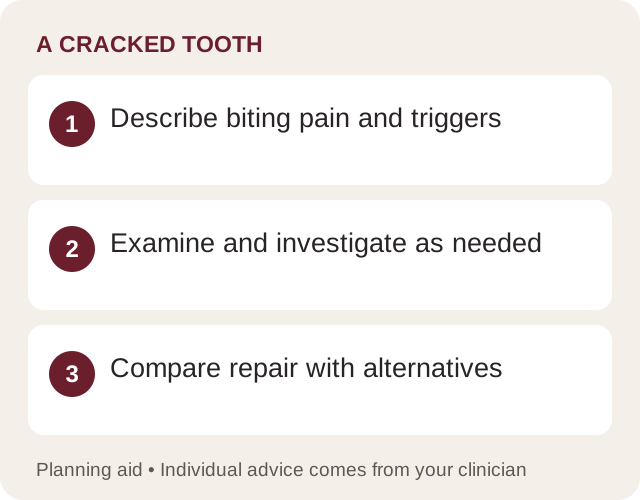
A cracked tooth is a possible explanation for pain on biting or sensitivity to temperature, but those symptoms do not identify the depth of a fracture or prove which treatment you need. A dentist needs to examine the tooth, the surrounding gum and the rest of the bite. A small chip in enamel, a crack approaching the pulp and a tooth that has split into separate parts are different problems. Some can be restored; others have a poor prognosis. The distinction matters more than choosing a crown material or booking an extraction before you are examined.
If you are travelling to Seoul, arrange assessment promptly where you are rather than waiting for a trip when symptoms are severe or worsening. An online photograph or a quote can help a clinic plan a consultation, but neither can demonstrate how far a hidden crack extends. Treatment and return visits may change after the examination. Ask for a provisional plan and a clear explanation of what would make it change.
References: American Association of Endodontists: cracked teeth · NHS: chipped, broken or cracked tooth
When to seek urgent help
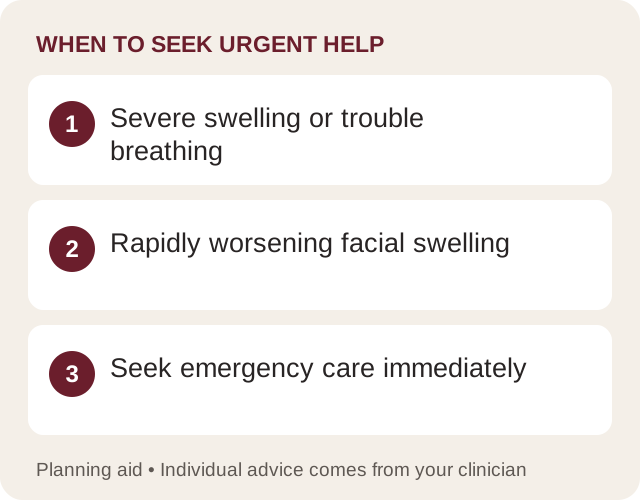
Contact a dentist promptly after a tooth chips, cracks or breaks, even if the pain has settled. Ask for urgent dental advice if pain is severe, keeps you awake or affects daily activities, or if a swelling is enlarging. These symptoms need an assessment rather than a promise that the tooth can be treated on an elective travel schedule. The urgency depends on the injury and symptoms, so tell the clinic what happened and whether you can eat and drink.
Get immediate local emergency care for severe swelling affecting breathing or the eye, uncontrolled heavy bleeding, serious facial or jaw injury, or a head injury with loss of consciousness, vomiting or double vision. Do not wait for an overseas clinic to answer a message. Emergency numbers and services differ by country; use the local emergency service. A dentist can then assess the tooth once immediate medical concerns are addressed.
References: NHS: urgent and emergency dental care · NHS: chipped, broken or cracked tooth
What the symptoms can and cannot tell you
A crack can produce pain when you bite or when pressure is released. Some people notice brief cold sensitivity; others have intermittent discomfort that is difficult to locate. A fractured filling, an inflamed pulp, gum disease or another tooth can produce overlapping symptoms. A visible line is not a reliable map of a crack underneath the surface, and the absence of pain is not proof that the tooth is undamaged.
Record when the discomfort began, which side you were chewing on, whether the pain occurs with cold or heat and whether it lingers after the stimulus ends. Mention any recent impact, very hard food, grinding, new filling or crown, previous root canal, and any swelling. Do not repeatedly bite hard objects to reproduce pain. This history helps the clinician choose tests, but an examination is still needed to interpret the pattern.
References: American Association of Endodontists: cracked teeth
Different cracks, different decisions
Very fine surface lines limited to the enamel are often called craze lines. They are common and may not cause symptoms. A fractured cusp is a broken piece of the chewing surface, sometimes next to a filling. A dentist may assess whether a replacement filling or a protective restoration is appropriate. By contrast, a crack running from the chewing surface toward the root can be more difficult to assess. The condition of the pulp and the extent and direction of the crack matter.
A split tooth has distinct segments and may not be restorable as a whole. A vertical root fracture can present differently and requires assessment of the root and surrounding bone. These names are descriptions, not diagnoses you can assign from a phone picture. Ask the dentist to show you the suspected line and explain what is known, what remains uncertain, and whether the root and gum attachment appear to permit a durable restoration.
References: American Association of Endodontists: cracked teeth
How an examination may locate the problem
A dentist will usually start with your history and a visual examination. They may examine individual cusps and existing fillings or crowns, check how your teeth meet, and test response to cold or other stimuli. A bite test, illumination or magnification may be used when appropriate. The dentist may also check gum pockets and assess neighbouring teeth, because pain can be referred and a crack may not be the only possible cause.
An X-ray may help assess roots, surrounding bone or other causes, but a crack itself may not be visible on a routine image. Additional imaging is not automatically necessary for every tooth; ask what a proposed image is expected to change. Sometimes removal of an old restoration reveals more information, which may also mean that the final decision cannot be made until treatment has begun. Ask about this possibility before consenting.
References: American Association of Endodontists: cracked teeth
Why the first plan may be provisional
The key questions are whether enough sound tooth remains above the gum, whether the crack extends into a location that can be restored, and whether the pulp and surrounding supporting tissues are healthy. Even after testing, the deepest extent of a crack can remain uncertain. A clinician may propose staged investigation and a temporary restoration before committing to a final crown or extraction. The precise sequence depends on what they find; temporary treatment is not a guarantee that a tooth can be saved.
Ask the clinic to explain the best, intermediate and worst reasonable findings, and how each would change the plan. If another diagnosis remains possible, ask what would distinguish it. A second opinion from a dentist experienced in saving teeth can be useful where the choice is irreversible and there is time to obtain one safely. Do not delay urgent care for progressive swelling or serious symptoms while arranging a second opinion.
References: American Association of Endodontists: cracked teeth · NHS: urgent and emergency dental care
When bonding, a filling or a crown may be considered
A small broken area may be repaired by bonding a fragment, placing a filling or building a protective restoration, depending on its position and the remaining tooth. If you recover a fragment, the NHS advises keeping it in milk or saliva in a clean container and taking it to the dentist; the dentist can assess whether reattachment is possible. Do not try to glue it yourself.
A crown covers a prepared tooth and can help protect a suitable cracked tooth, but it is not a universal answer. The amount of remaining tooth, the bite and the position of the fracture influence whether a filling, onlay, crown or another approach is appropriate. Ask what tooth reduction is required, whether a temporary restoration is needed, how the bite will be checked and what the quoted fee includes. The goal is function and protection, not an appearance-led decision made before diagnosis.
References: NHS: chipped, broken or cracked tooth · American Association of Endodontists: cracked teeth
When root canal treatment may enter the discussion
The pulp is the soft tissue inside the tooth. When a crack affects it, the pulp may become inflamed or infected. Depending on examination findings, a dentist may discuss root canal treatment to remove diseased pulp tissue, clean and fill the canals, followed by an appropriate restoration. A root canal treats the pulp; it does not make a crack in the tooth disappear. The need for a crown or other protection depends on the tooth and the clinician’s assessment.
Not every painful or cracked tooth needs a root canal. Ask which tests support the recommendation, whether the proposed restoration can be placed with sufficient sound tooth, and whether referral to an endodontist is useful. OnO Dental Clinic’s international website lists cavity and root canal treatment; its listed service may be relevant for discussing tooth preservation. Contact it to ask whether the team can assess your specific fracture and what records it needs, rather than assuming the tooth is suitable for treatment.
References: American Association of Endodontists: cracked teeth · OnO Dental Clinic: cavity and root canal treatment
When extraction may be recommended
If a crack extends too far or the tooth is divided in a way that cannot be predictably restored, extraction may be advised. This is a decision about the particular fracture and the support available, not simply the presence of any crack. Ask the dentist to explain the evidence and whether a specialist opinion could change the assessment. In some cases, a carefully selected part of a tooth may be retained or surgically managed, but this is not suitable for every fracture.
Before removal, ask about replacement choices and the consequences of leaving a space. Depending on the mouth and goals, options may include an implant, a bridge, a removable appliance or no immediate replacement. Each has different effects on neighbouring teeth, timing and maintenance. If infection or pain needs urgent attention, immediate care may come first; a later replacement decision can still be made after you understand the alternatives.
References: American Association of Endodontists: cracked teeth
Comfort and protection while waiting for assessment
A cracked tooth needs professional evaluation. Until you can be seen, avoid chewing on that tooth and avoid very hard foods or objects that could further damage it. Choose foods that are comfortable and avoid a temperature trigger if it provokes pain. Keep the area clean with gentle routine oral care. Do not put aspirin on the gum or apply an unprescribed topical product to the tooth. A pharmacist can help you check whether an over-the-counter pain medicine is appropriate for you, taking account of your medical history and other medicines.
Do not use pain relief to postpone care when symptoms worsen. Increasing swelling, fever, uncontrolled bleeding or facial injury changes the urgency. Temporary filling products and glue are not substitutes for diagnosing the fracture. If a temporary restoration is placed by a dentist, ask how long it is intended to last, which foods to avoid and what to do if it breaks before your next appointment.
References: American Association of Endodontists: cracked teeth · NHS: urgent and emergency dental care
Planning treatment around travel to Seoul
A cracked tooth does not follow a reliable one-visit timetable. An examination may reveal the need for a temporary restoration, a referral, root canal treatment, a laboratory-made crown or a change in the proposed plan. Ask the clinic for the expected sequence after assessment, how long any laboratory work might take and whether time is reserved for fit or bite adjustments. Avoid booking a flight immediately after an uncertain procedure without discussing the plan with the treating dentist.
Before committing to travel, ask whether the clinic accepts previous radiographs and records securely, whether it can examine the tooth in your preferred language, and how it handles an urgent change in symptoms. Confirm the consultation fee, what the written estimate includes, and the cost of imaging, temporary care, root canal treatment, a final restoration and adjustments if these become necessary. A quote before examination is a planning estimate, not a guarantee of the final treatment.
References: American Association of Endodontists: cracked teeth · OnO Dental Clinic: cavity and root canal treatment
Arrange continuity before you leave
Ask for a written diagnosis, the tests performed and copies of relevant images and treatment notes. The record should identify the tooth using a numbering system that your home dentist can interpret, and distinguish a temporary restoration from the final treatment. Request clear instructions for cleaning, diet, medicines and any planned review. If a crown or other restoration is placed, ask how a problem with the fit or pain on biting should be assessed after your return.
Agree on who will review the tooth and when. If a root canal or other treatment is staged, clarify whether it is clinically sensible to transfer the remaining work to your home dentist and make that arrangement before travel. Ask how to contact the Seoul clinic and what information can be shared with a receiving dentist. A remote message cannot replace urgent local examination if symptoms change.
References: OnO Dental Clinic: cavity and root canal treatment
What to ask before deciding
Bring a short list to your assessment: Where is the suspected crack, and what evidence supports that diagnosis? Is the pulp affected or is this still uncertain? Is there enough tooth above the gum for a restoration? What will become clear only after an old filling is removed? Which options could preserve the tooth, and what are their limitations? What is the risk that the crack progresses despite a restoration?
Also ask who will carry out each stage, whether specialist referral is appropriate, the proposed interval between visits, what happens if the tooth cannot be restored, and how follow-up will work after you leave. Request a written estimate with temporary and final treatment listed separately. These questions are useful whether treatment occurs in Seoul or at home; they help compare complete pathways rather than advertised starting prices.
References: American Association of Endodontists: cracked teeth
Common patient questions
Can a crack heal on its own? Tooth structure does not knit together like bone. Treatment aims to protect or restore a suitable tooth and manage the pulp when necessary, but a crack can continue to progress despite treatment. A dentist can explain the prognosis for your particular tooth; a crown cannot promise permanent success.
Does no pain mean no treatment is needed? Not necessarily. Symptoms vary and a damaged tooth should still be assessed. A painless surface line may require a different response from a deeper fracture. Do I always need extraction? No. Depending on the fracture, filling, bonding, a crown or root canal treatment may be considered; an unrestorable tooth may need removal. Can an online image settle the question? No. It may help a clinic triage an appointment, but it cannot replace tests of the tooth and surrounding tissues.
References: American Association of Endodontists: cracked teeth · NHS: chipped, broken or cracked tooth
A relevant Seoul consultation option
OnO Dental Clinic is listed on this platform and its international website describes cavity treatment and root canal therapy as tooth-preserving services. For someone whose cracked tooth may need assessment of its pulp or a restoration, those published services make it a relevant place to ask whether the clinic can assess the problem. Review the clinic profile and the official service page, then ask about the particular tooth, the availability of an endodontic opinion, diagnostic fees and how follow-up would be arranged.
This is a service-based listing, not a ranking, a guarantee that a particular tooth can be saved, or a claim that the clinic accepts every case. Confirm appointment availability and the scope of care directly. If symptoms suggest a medical emergency, seek immediate local emergency care rather than waiting for a consultation response.
References: OnO Dental Clinic: cavity and root canal treatment · NHS: urgent and emergency dental care
Explore the care and related reading
Explore the listed clinic profile — OnO Dental Clinic >
Explore the clinic’s international website — OnO Dental Clinic >
Explore related care in Seoul
These profiles describe published clinical interests and services. Compare the team and ask whether the proposed care fits your diagnosis.
- Lime Tree Dental Hospital — Myeongdong
- Magok Pureunmaeum Dental Clinic — Magok · Gangseo
- Dr. Minji Kang — Conservative dentistry and tooth restoration at Lime Tree Dental Hospital.
- Dr. Park Hyo Jin — Conservative dentistry and aesthetic restoration at Magok Pureunmaeum Dental Clinic.
Clinical references and further reading for the explanations on this page. The guide is general patient education; your dentist determines the plan for your examination findings.
American Association of Endodontists: cracked teeth >NHS: chipped, broken or cracked tooth >NHS: urgent and emergency dental care >OnO Dental Clinic: cavity and root canal treatment >